


100 Years of Matsuya Ginza
Ginza 3-Chome Centennial Chronicle
Episode 3
Thanks to your continued support, Matsuya Ginza celebrates its 100th anniversary in 2025.
In this special series, we revisit the unique stories and moments that have unfolded in Ginza 3-Chome, as we explore the spirit and identity of Matsuya Ginza.
Central Hall
When it comes to the most iconic space within the Matsuya Ginza building, the open atrium of the Central Hall surely comes to mind.
Atriums have long been a hallmark of classical department stores. The world’s first department store, Le Bon Marché in Paris, as well as Japan’s first, the Nihombashi Mitsukoshi Main Store, both feature magnificent atrium spaces that bring a sense of openness and grandeur to the store.

As mentioned in the first episode of this series, the Ginza branch of Matsuya Gofukuten originally began as a construction project for an office building known as the “Ginza Building” during the Taishō era. It was later redesigned for use as a department store, and the most significant change in that redesign was the creation of the Central Hall.
Yasuzo Kida of the Kida-gumi construction firm, who oversaw the project, had conducted numerous overseas inspections. As a result, the hall was born with an open atrium crowned by a stained glass dome and a first floor paved in a black-and-white marble checkerboard pattern.
Yasuzo Kida was also the architect behind the Shirakiya department store in Nihombashi and the Marui Imai store in Hakodate.
A major transformation of the Central Hall came in September 1956 (Shōwa 31), when a “Sky Ribbon” escalator system—suspended in midair, offering a view down into the hall—was completed between the 1st and 4th floors (the 5th to 7th floor portion was completed in March of the following year).
This charming nickname, “Sky Ribbon,” was selected from a public contest that drew a remarkable 12,063 submissions.

From 1959 to 1963 (Shōwa 34–38), the “Spatial Form Series” was held a total of ten times in the Central Hall. This groundbreaking event featured participation by artists and designers such as Tarō Okamoto, Yūsaku Kamekura, and Seiji Fujishiro, and can be regarded as a forerunner of modern public art and installation exhibitions.
The second edition of the series was held throughout the year in 1969 (Shōwa 44), comprising eight exhibitions. It drew significant attention with bold displays in the Central Hall, including an enormous paper lantern, a Cessna airplane, and even a yacht.
The Central Hall also made a cameo in the 1962 (Shōwa 37) film Ginza Love Story (Ginza no Koi no Monogatari), which featured a fictional department store broadcasting room located on the landing beside the staircase, where the heroine—played by Ruriko Asaoka—worked as a store announcer. In one scene, the male lead, portrayed by Yūjirō Ishihara, is shown dashing down this staircase.
In 1989 (Heisei 1), the year the Shōwa era gave way to Heisei, Matsuya commemorated its 120th anniversary with a full-scale renovation of the entire store. As part of this renovation, the Central Hall—formerly an open space connected to each floor—was enclosed on all but the escalator side with walls and glass panels. It was also renamed “Space of Ginza (SOG),” a title that remains to this day.
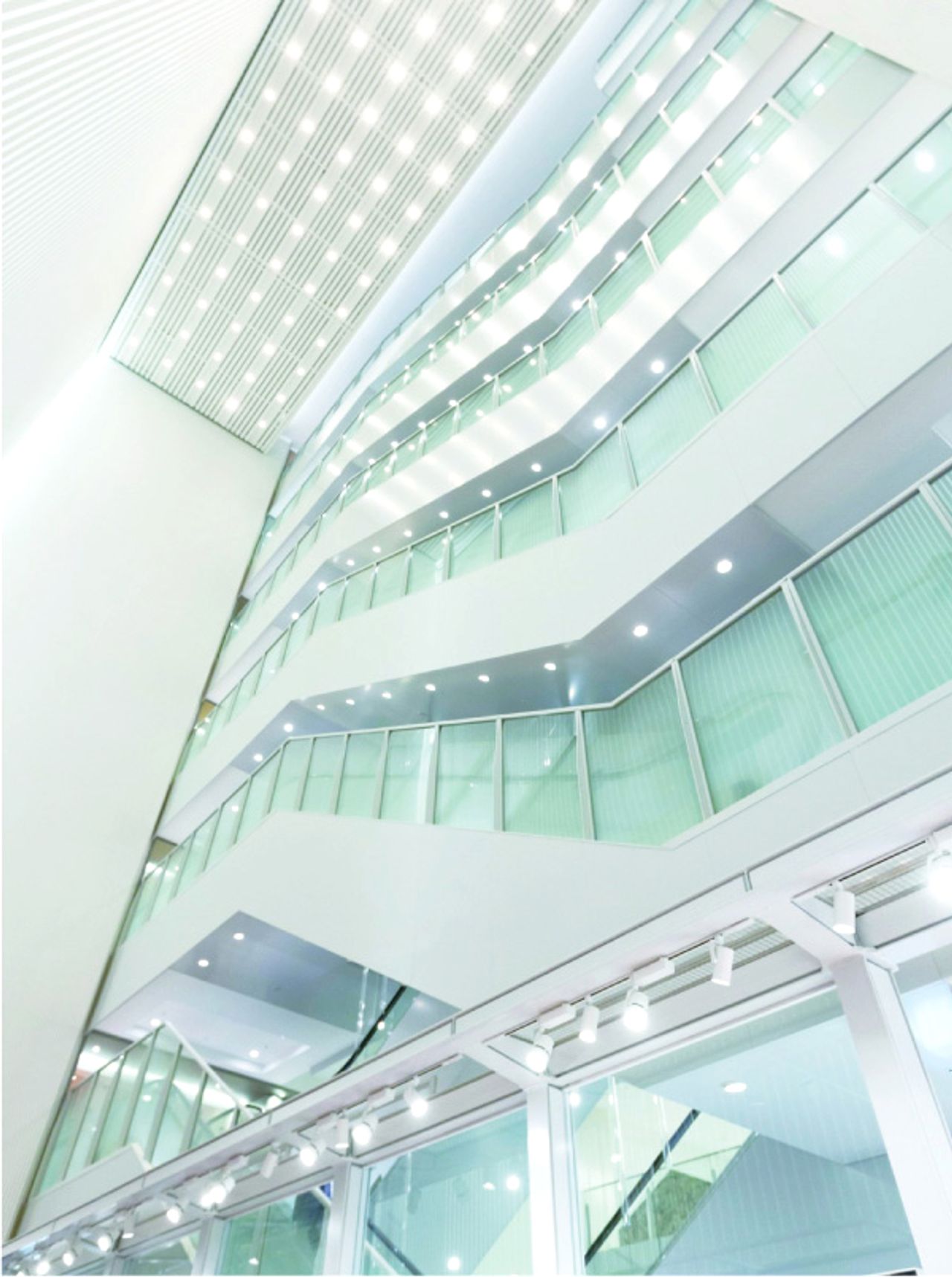
Time passed, and in 2017 (Heisei 29), another major renovation was carried out, including seismic reinforcement. The SOG was completely redesigned, transformed into a simple and elegant space dominated by Matsuya’s corporate identity color: white. Due to the addition of steel structural supports for earthquake safety, the space became slightly smaller than before.
The Central Hall continues to host signature seasonal events, including the beloved Hyakusan-kai (Hundred Umbrellas Exhibition) and festive Christmas displays.
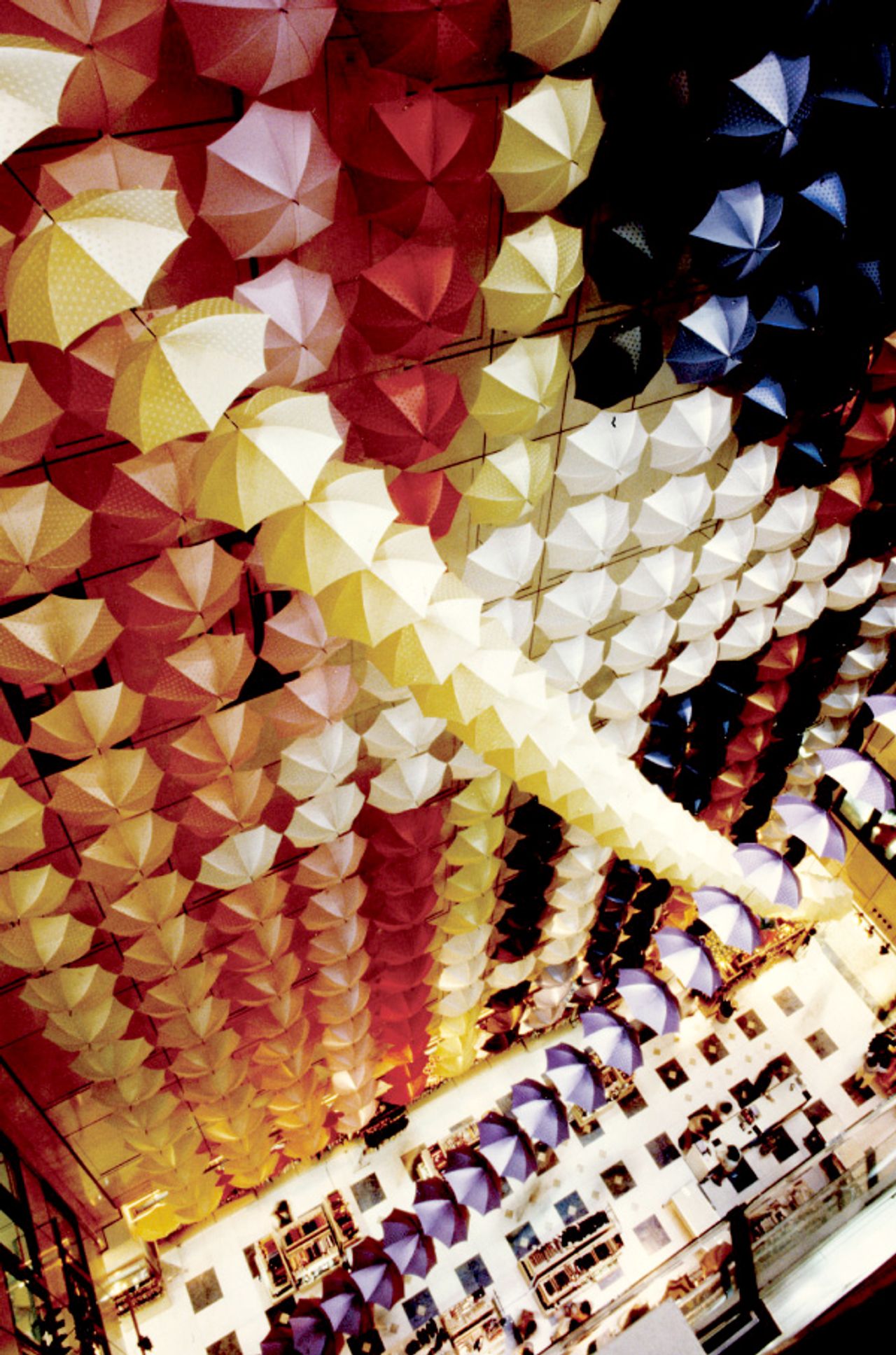
Umbrellas, Christmas trees, Santa Claus Nebuta floats, chairs, passenger ships, jet planes, pine trees, golden dragons, mannequins in swimsuits, shimmering silver stars... Over the course of a hundred years, countless items have adorned this space.
The 25-meter-tall atrium spanning seven floors will undoubtedly continue to be cherished as a beloved symbol of Matsuya Ginza for years to come.
Written by: Ken Tashiro
Principal of the Tokyo Fashion College, part of the Matsuya Group.
With over 40 years of experience dedicated to the group, he has served in various roles including Deputy Editor of The 150-Year History of Matsuya.

Previous and next issues available here