


100 Years of Matsuya Ginza
Ginza 3-Chome Centennial Chronicle
Episode 9
Thanks to your continued support, Matsuya Ginza celebrates its 100th anniversary in 2025.
In this special series, we revisit the unique stories and moments that have unfolded in Ginza 3-Chome, as we explore the spirit and identity of Matsuya Ginza.
Expansion of the Ginza Store and the Sanjikkenbori River
Matsuya Ginza opened on May 1, 1925 (Taisho 14). At that time, it was called Matsuya Gofukuten Ginza Store. Its size is shown as area A in the diagram, which is less than half the current size. After the postwar GHQ occupation ended, when Matsuya resumed operations in 1953 (Showa 28), the area shown as B in the diagram was added to the store. However, the first and second floors of area B were occupied by other companies (banks).

In 1964 (Showa 39), the year the Tokyo Olympics were held, a large-scale expansion took place. With the catchphrase “A wide department store bursting with youth,” Matsuya proudly promoted that its size had roughly doubled. The area marked as C was added, making the entire Ginza 3-chome block part of the store. However, the first and second floors of the northwest corner were occupied by the Tokyo Bank. In November 2000 (Heisei 12), Louis Vuitton moved into that corner, completing the current form where the entire Ginza 3-chome block belongs to Matsuya.

By the way, many people might be surprised to learn that a large river once flowed behind the Ginza store for some time after the war. This river, called the Sanjikkenbori River, was a canal running north to south through Ginza from 1-chome to 8-chome. Originally, during the time Tokugawa Ieyasu entered Edo, the current Ginza area was part of a peninsula called Edo-Maeshima. That shoreline became the west bank of the Sanjikkenbori River. Later, stones were piled offshore to create reclaimed land on the sea side, leaving the remaining waterway as the Sanjikkenbori River. The name comes from the river’s original width of about 30 ken (approximately 55 meters), although it was later narrowed.
In the section around Ginza 3-chome, the river ran from two blocks beyond Matsuya, where the Asahi Inari Shrine now stands, extending roughly to the middle of the block where the Paper and Pulp Hall is located. Simple buildings lined both banks of the river.
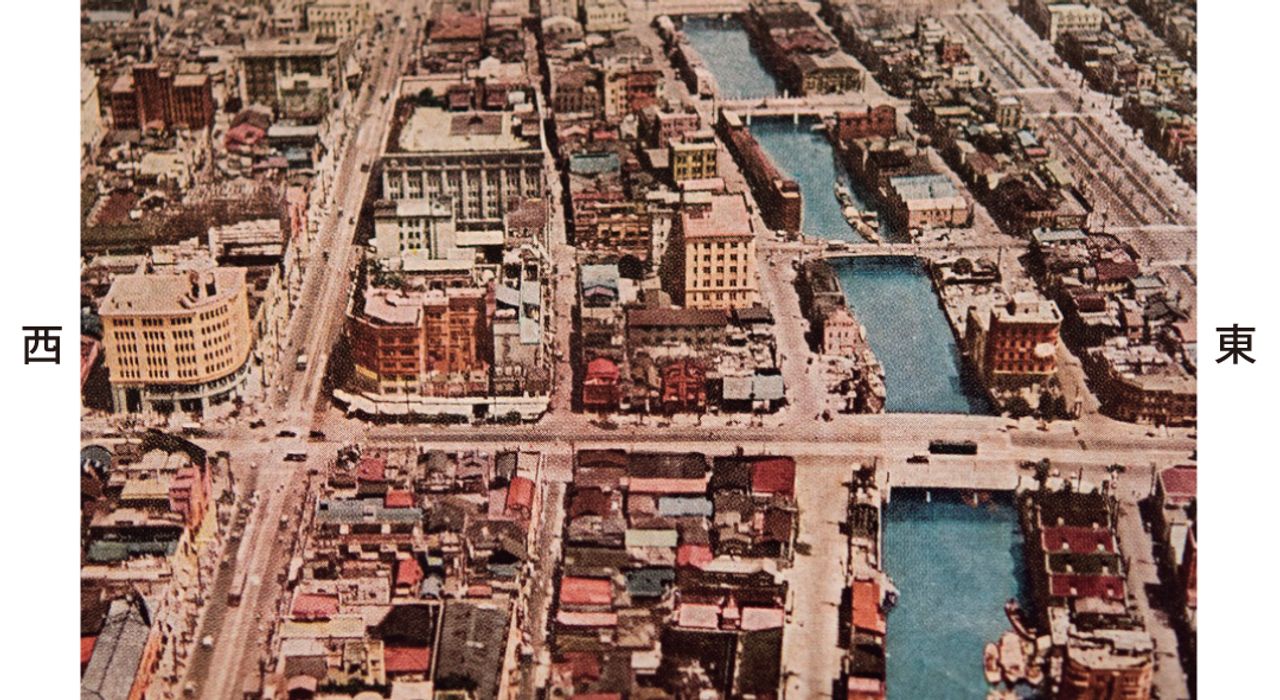
Toward the end of World War II, Tokyo was repeatedly subjected to air raids, and the Ginza district was no exception. For some time after the war, Ginza was a "burnt-out wasteland" covered with rubble from destroyed buildings. To deal with this rubble, it was decided in June 1948 (Showa 23) to fill in the Sanjikkenbori River. The reclamation work was completed in July 1952 (Showa 27). On the reclaimed land, long narrow buildings were built one after another, and nowadays it is hard to believe that a river once flowed here. However, standing on such a street corner and imagining the scenery from when the river was still there can be a charming and stylish pastime.

Author: Ken Tashiro
Principal of the Tokyo Fashion College of the Matsuya Group. With a career spanning over 40 years dedicated to the Matsuya Group, he has served as deputy editor for the "150-Year History of Matsuya" and held various other key roles.

Previous and next issues available here